The Shanghai Grand Opera House opened its doors on October 17, 2026, unveiling a 146,786-square-meter complex designed by Norwegian architecture studio Snøhetta. Set on the banks of the Huangpu River, the building brings three auditoriums with a combined 4,200 seats, rehearsal and production spaces, exhibition areas, restaurants, and educational facilities to the city’s Expo Houtan district. The project was developed in collaboration with East China Architectural Design & Research Institute, Theatre Projects, and Nagata Acoustics, following Snøhetta’s winning entry in the 2016 international competition and formal commissioning as a consortium in 2019.
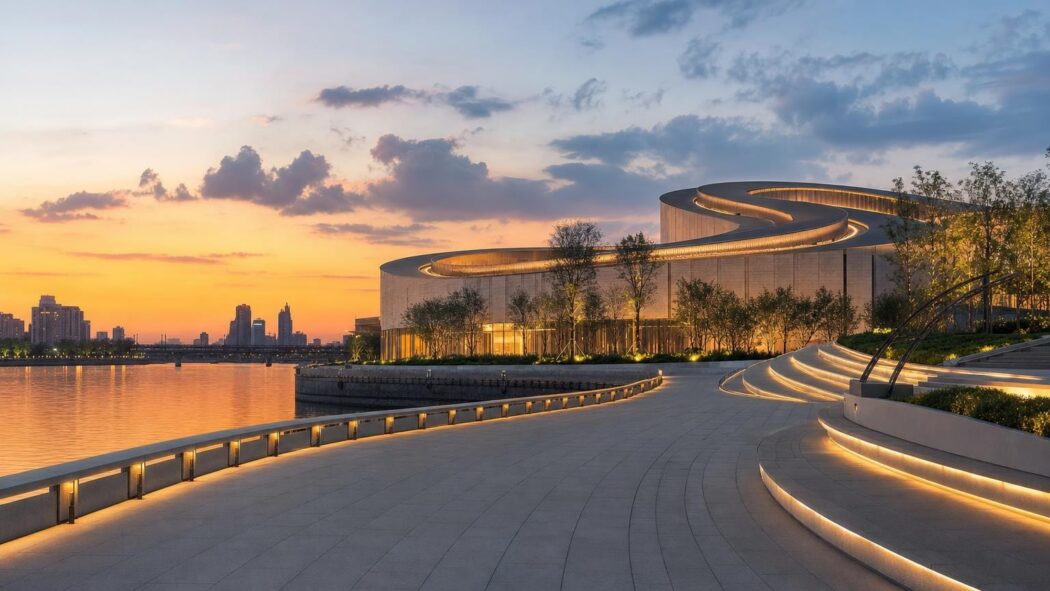
Snøhetta’s design is defined by a sweeping white roof that rises in a continuous spiral, inspired by the movement of the Huangpu River and the geometry of a traditional Chinese fan. The roof functions as a public observation deck, accessible by a spiraling staircase that connects ground level to the elevated platform. This rooftop, open to all, offers panoramic views of Shanghai’s skyline and serves as both an informal stage and a year-round gathering space.
The building’s geometric facade balances transparency and enclosure, with expansive glass surfaces introducing natural light into the shared interiors. After dark, exterior lighting transforms the stage towers into illuminated volumes visible from the surrounding park and waterfront. At ground level, the arrangement of paths and plantings continues the building’s geometry into the neighboring park, connecting the Opera House with the riverfront. The inclusion of restaurants, exhibition spaces, and educational areas ensures the complex remains active beyond scheduled performances.
The Opera House sits within a park that’s open to the public, with the structure placed to look out toward both the river and the city. The white exterior is kept minimalist, and the main lobby and circulation spaces are marked by bold red-accented volumes. These red elements, visible through the glass facade, are arranged to follow acoustic principles and recall the deep colors of traditional theater interiors.
Inside, the design shifts from the predominantly white exterior to richly textured performance spaces. Harmony Hall, the largest auditorium, seats 2,000 guests across five levels and features a dark-red interior tailored to enhance vocal acoustics. Carefully positioned balconies and side boxes bring audiences closer to performers. The 1,200-seat Soar Theatre provides a more intimate setting for classical opera and regional productions, while the 1,000-seat Open Stage offers adaptable seating and stage configurations for experimental performances, with views toward the park.
Each auditorium carries its own character, with color palettes transitioning from darker to lighter tones, establishing a visual hierarchy and reflecting their different atmospheres. The architects have calibrated the arrangement of volumes and seating to follow modern acoustic principles and to keep the audience close to the live program. Circulation routes and fluid spatial connections guide visitors through the building, making movement a central part of the experience.
The Opera House was designed to accommodate a wide range of performances, from traditional opera and classical music to more experimental and contemporary productions. The building’s technical requirements were developed with input from Theatre Projects and Nagata Acoustics, and the three auditoriums were each given their own scale, atmosphere, and technical setup. The public spaces, including the rooftop and the park, were conceived to invite visitors regardless of whether they hold a ticket, making the building part of daily life in the city.
Snøhetta’s approach extends beyond technical and aesthetic demands, aiming to make the Opera House a civic space as much as a cultural one. The studio writes, “Beyond its role as a venue, the Opera House creates a shared framework for artistic expression and civic life.”
The inaugural season, running through February 20, 2027, will present 82 performances across 47 productions. The rooftop remains accessible to the public year-round, requiring no admission ticket. The magazine has also looked at the luxurious David Chipperfield-designed London penthouses, another example of architecture shaping urban life.
Sources
- Designboom: snøhetta unveils completed shanghai grand opera house with spiraling public rooftop, October 17, 2026
- Wallpaper: The Shanghai Grand Opera House opens as a venue for all, bridging performance and city, October 17, 2026