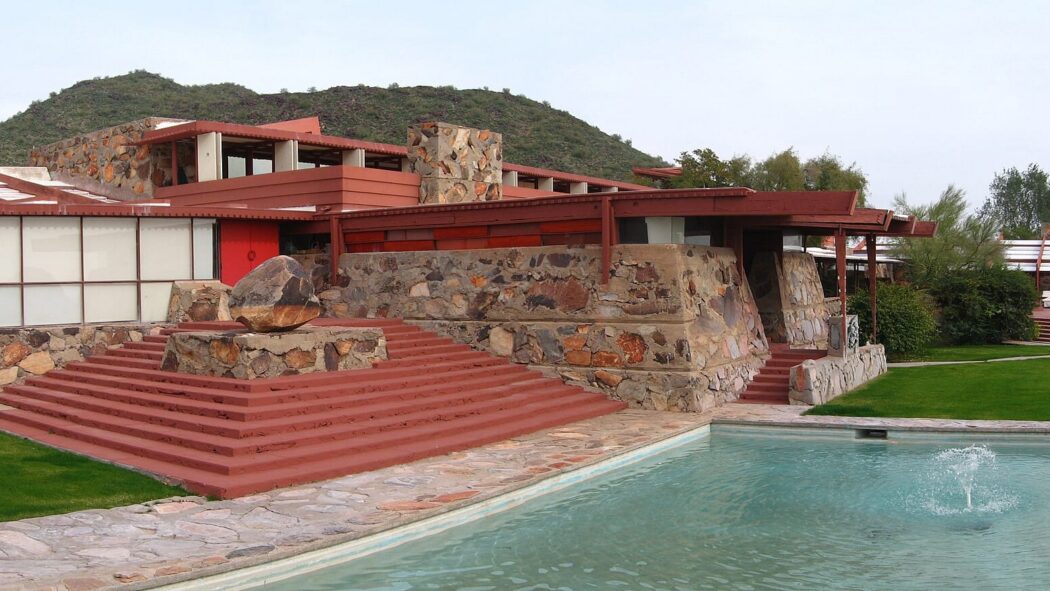
Taliesin West, Frank Lloyd Wright’s winter home and studio in Scottsdale, Arizona, will reopen to the public on Saturday, October 24, at 10 a.m., according to the Frank Lloyd Wright Foundation, following a fatal accident that closed the site for safety inspections. The incident occurred on October 16, when a piece of acrylic roofing was dislodged by strong winds and struck Rogério Renato Mateucci, the rector of the Pontifical Catholic University of Paraná in Brazil, during a guided tour. The Scottsdale Fire Department reported that Mateucci died instantly at the scene. No other injuries were reported.
The accident took place as wind gusts reached up to 32 miles per hour, according to local weather services. Mateucci was in Arizona to participate in an event at Arizona State University and had joined a sightseeing tour of the UNESCO World Heritage site after meetings with other university leaders. Police are treating the incident as weather-related, and the Frank Lloyd Wright Foundation, which manages the property, closed Taliesin West to allow for a full safety inspection and to cooperate with authorities. “The Foundation mourns the loss of Rogério Renato Mateucci, who tragically died on October 16 in an accident at Taliesin West,” Joseph Specter, president and CEO of the Frank Lloyd Wright Foundation, said in a statement.

Taliesin West was designed by Wright in 1937 as a winter retreat and studio, conceived as a desert camp that responded to the Sonoran landscape. The original roof was made of lightweight canvas, which could be opened or closed to control airflow and temperature, but wasn’t waterproof. Over the decades, as the building transitioned to year-round use, the Foundation replaced the canvas with more permanent materials: first fiberglass panels in the late 1950s, then insulated acrylic panels in the 1990s. The Foundation has been working to replace these acrylic panels, which are “nearing the end of their serviceable life,” with a more resilient material that recalls Wright’s original vision, according to Rebecca Barron, director of preservation at Taliesin West.
The Foundation says it closed the site to allow for a safety inspection of the roofing and structures. Scottsdale police confirmed that Mateucci was struck by a piece of acrylic glass, though the Foundation did not comment on the specific condition of the roof at the time of the incident. In response to the tragedy, the Foundation has added weather station technology to the site to monitor temperature, wind speed, air pressure and rain, aiming to provide localized data for daily safety decisions. “Weather station technology has been added to enhance our existing safety procedures at the site, to assess temperature, wind speed, air pressure, and rain. This will offer the Foundation localized safety data to further inform the daily practice of opening our site to the public,” Specter said.
The death of Mateucci, described by colleagues as a man of “rare gentleness” and deep appreciation for the intersection of art and science, has prompted reflection among those who knew him. Paulo Mussi Augusto, associate vice president for global education at Kent State, said, “He loved beauty and found it where art and science met. As a man of faith, he was steadfast, slow to judge, and always willing to give people another chance.”
The Foundation plans to use new weather monitoring equipment to guide daily decisions about opening the site. The magazine has also looked at the Stahl House’s continued tours during its sale.
Sources
- Architectural Digest: Frank Lloyd Wright’s Taliesin West Reopens After a Freak Accident Caused a Visitor’s Death, October 20, 2026
- The Art Newspaper: Frank Lloyd Wright’s Taliesin West closes after visitor killed by wind-blown debris, October 21, 2026
- ArchDaily: Frank Lloyd Wright’s Taliesin West Closes After Fatal Accident, October 20, 2026
- Yahoo: Tourist Dies from Falling Debris During Tour at Frank Lloyd Wright’s Taliesin West, October 20, 2026