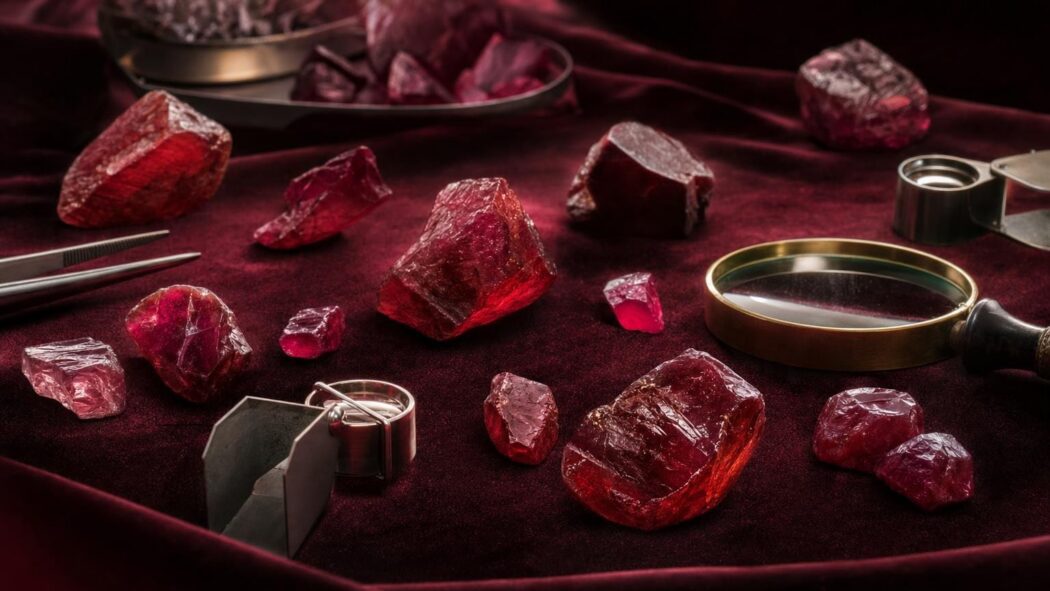
Gemfields raised $52 million in its latest mixed-quality rough ruby auction, held October 5 to 16 with in-person viewing in Bangkok and sealed online bids. All 90 lots sold came from the Montepuez Ruby Mine (MRM) in Mozambique’s Cabo Delgado province, a site Gemfields calls one of the most significant ruby deposits discovered in recent decades. The company owns 75% of MRM, with the remaining 25% held by Mozambican partner Mwiriti Limitada.
The average price achieved across all lots was $564.54 per carat, nearly double the $279.39 average of Gemfields’ February sale. According to the company’s published results, this marks the highest average price for any of its mixed-quality ruby auctions. The auction included just over 20 kilograms of rough stones and was made up mostly of higher-quality rubies, as noted by Adrian Banks, Gemfields’ managing director of product and sales. Banks stated, “The lower volume reflects the year’s operational challenges and the Trade Select auction strategy introduced in June, under which selected grades and categories are now offered separately.”
This year, the mine faced heavy rain in the first quarter and difficulties in commissioning a new processing plant, which limited access to the most favorable areas of the concession. Gemfields also reported attacks on nearby villages earlier in the year and ongoing problems with illegal mining, with more than 1,000 people entering the concession each day. Despite these challenges, 46 companies placed bids in the October auction, and 90 of the 99 lots offered were sold.
All proceeds from Gemfields’ ruby auctions are fully repatriated to Mozambique, with royalties paid to the government on the full sales price. The company did not respond to questions about how recent changes to Mozambique’s mining law, which require the state to hold a minimum 15% stake in mining projects, potentially rising to 20% as announced by President Daniel Chapo, might affect the Montepuez operation.
Mining at Montepuez is an open-pit, mechanized process, extracting rubies from both primary rock formations and secondary alluvial deposits. The latter, shaped by ancient rivers, often yield higher-value stones. After extraction, ore is processed with recycled water and sorted using optical machines and hand grading, before the rubies are prepared for auction. Gemfields reports that 95% of the mine’s workforce are Mozambican nationals, and that the operation is certified to international standards for environmental management, occupational health and safety, and quality.
The Montepuez Ruby Mine covers 33,600 hectares in northeast Mozambique, where the presence of rubies became widely known in 2009. The region sits at a geologically significant junction between two ancient rock belts, created over a period stretching from 500 million to 800 million years ago. In the north, the area is shaped by a Precambrian basement section of the Mozambique Belt, which extends north to the Mediterranean. In this basement, large areas underwent high-temperature and high-pressure metamorphosis during the Pan-African tectonic event, creating conditions for gemstone formation. These deposits are much older than the gem deposits of the Himalayan range, such as those in Myanmar, which are only 40 million years old.
Mining at Montepuez doesn’t use tunnels but instead relies on a largely mechanized open-pit method. Rubies are found in gravel close to the surface or up to ten meters below. The topsoil is removed and saved to be returned with indigenous plants once mining is complete. The recovered gravel, or ore, is processed at a wash plant using recycled water. A dense medium separation plant sorts the material by weight, and optical sorting machines use ultraviolet light to identify rubies, which are then separated by jets of air. The remaining gravel is then examined by hand, using sealed boxes with windows, and the stones are sorted by color, size, shape, and clarity.
After auction, the rough rubies typically enter international markets for cutting and polishing, most often in Thailand, before being sold to jewelry houses, designers, collectors, or gemstone traders. The magazine has also reported on the most expensive jewelry pieces in the world.
Sources
- Gemfields: Montepuez Ruby Mine
- JCK: Mozambique Rubies Bring In $52 Million at Gemfields October Auction, October 22, 2026