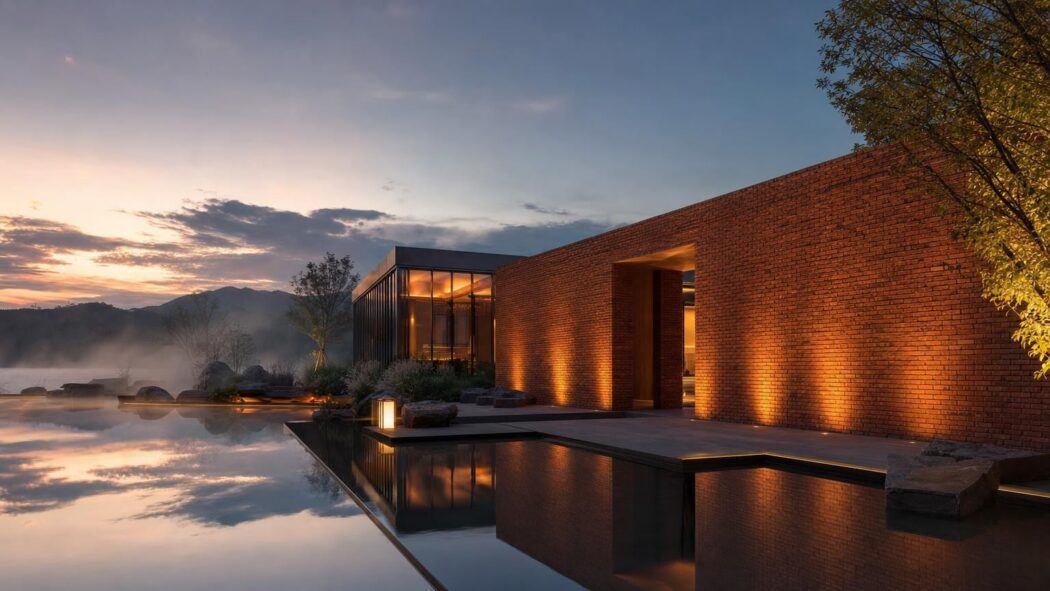
On December 5th, 2026, Kengo Kuma & Associates will open the KAI Water Culture House on Copenhagen’s Papirøen, also known as Paper Island. The 5,800-square-meter public bathhouse is marked by five irregular brick towers, each shaped around the pools beneath them, rising above a glazed base along the city’s harborfront. The project brings ten indoor and outdoor pools to the site, with spaces for swimming, bathing, and cultural events, all set within a building that responds directly to the city’s changing waterfront.
The exterior is defined by approximately 300,000 handmade bricks in varying gray tones, laid in a stepped pattern that gives the sloping towers a textured finish. Between the towers, 403 windows of different sizes frame views of the city and harbor, while the ground-level band of glass opens the interior to the waterfront. The tallest of the towers, known as the Culture Tower, is designed to house spaces for community gatherings and cultural programming. The design team included early-stage collaboration with Cornelius Vöge Atelier for Architecture and executive architect Vilhelm Lauritzen Architects, with the project commissioned by the Paper Island Water Culture House Foundation and funded by the City of Copenhagen and Nordea Fonden.
Inside, the pools are arranged across multiple levels. The ground floor contains a 25-meter fitness pool, a pool for instruction, and three pools intended for children. On the upper floor, guests find warmer bathing spaces, a cold plunge pool, saunas, and a steam bath. The building’s central feature is the Valley Pool, an open-air swimming basin set on the first floor between the brick towers, allowing visitors to swim under the sky and experience the weather from within the shelter of the masonry. Adjacent to this is a heated outdoor onsen, which overlooks Copenhagen Harbour and draws on Japanese bathing traditions. Both outdoor pools are kept warm throughout the year by a system that draws heat from ten deep boreholes beneath the site.
The bathhouse accommodates up to 380 swimmers at a time, with entry tickets expected to cost under 100 Danish kroner, in line with other city-run swimming facilities. The pools are open to both adults and children, with the intention, as stated by Copenhagen’s Lord Mayor Sisse Marie Welling, that the Water Culture House will become “the city’s new gathering point for water-loving Copenhageners and visitors alike.”
The project began in 2015 with a city-led ideas competition that attracted 160 proposals from Copenhagen residents, most of which called for a public swimming facility on Paper Island. Kengo Kuma & Associates won the subsequent international architectural competition in 2017. The building’s opening brings to completion nearly a decade of planning and construction, as part of a broader effort to transform the harbor from industrial use to public recreation and cultural life.
Beyond the building itself, a timber boardwalk will connect to designated harbor swimming and dipping areas with views toward the Royal Danish Playhouse and Opera Park. These outdoor facilities are scheduled to open in early 2027, shortly after the bathhouse’s inauguration. The magazine has also looked at the house’s earlier work in Japan.
Sources
- Designboom: kengo kuma’s brick towers frame open-air pools at copenhagen’s upcoming bathhouse, October 28, 2026
- Condé Nast Traveller: Copenhagen’s eight-year-long harbour project opens this December with 10 public pools, October 28, 2026
- ArchDaily: Kengo Kuma & Associates’ Water Culture House to Open in Copenhagen on December 5, 2026, October 28, 2026